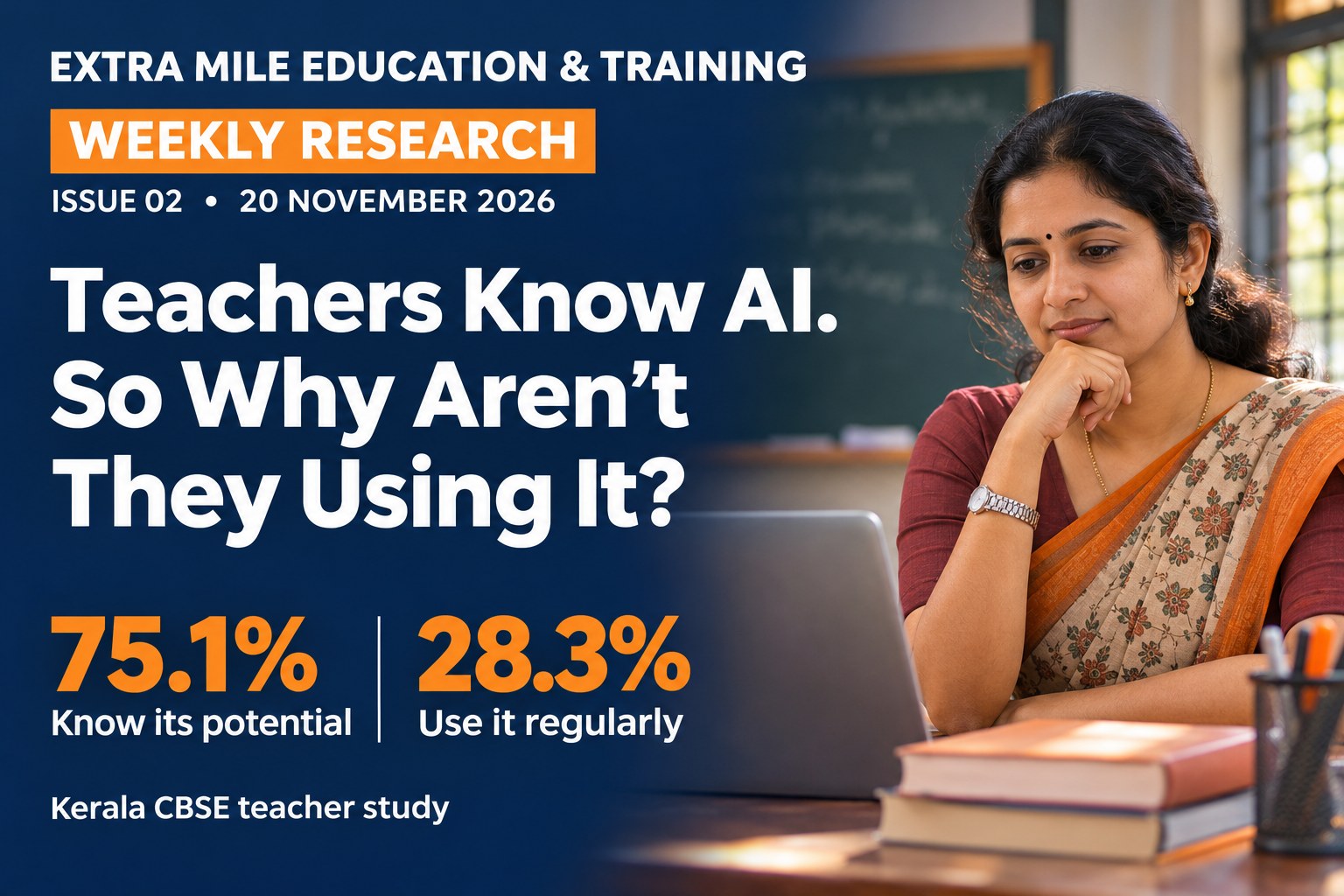
In the Kerala CBSE teacher study, 75.1% knew AI’s potential and 28.3% used it regularly.
Research 03 · Featured research
Why awareness hasn’t translated into classroom practice
Mariya Kutty Mathew · · Journal of Educational Leadership and Innovation
Method and sample. A mixed-methods study surveyed 106 CBSE teachers in Kerala and followed up with 20 interviews.
Finding. The study reports that 75.1% understood AI’s educational potential and 28.3% used it regularly in class. Teachers described limited infrastructure, insufficient practice-oriented training and uncertainty about school-level rules.
Limits. These self-reported findings describe the Kerala sample. The study did not test which intervention would increase classroom use.
Try this. Rehearse one AI-assisted lesson in a subject team. Provide an offline version, agree on what information may be shared with the tool, and review the student work at the next team meeting.
Can generative AI help students think more deeply?
Miao Yue, Morris Siu-yung Jong and Wenjiao Wang · 2026 · Computers & Education
Method and sample. A 13-week quasi-experimental study compared approaches to using AI and search with 101 upper-elementary students.
Finding. Students using generative AI with metacognitive scaffolds showed stronger learning outcomes. Students using AI without scaffolds performed similarly to those using a search engine. The scaffolds encouraged students to plan, monitor and reflect on their thinking.
Limits. The specific age group, tasks and research design limit how far the results can be generalized.
Try this. Ask students to write a plan before prompting AI, test one AI-generated suggestion against evidence, and explain what they changed and why. For computational thinking, have them trace and debug an algorithm before submitting their own explanation.
Can AI Really Save Teachers Time Without Compromising Lesson Quality?
International review · 5 February 2026. Luna Chontal and colleagues reviewed 16 records about large language models in teaching and planning. The evidence points to potential efficiencies in drafting and routine tasks. Much of it comes from shorter studies or higher education, so the size of the benefit in schools remains uncertain. Read the systematic review.
Germany · 2026 randomized experiment. Appel, Fervers and Piepenburg found that teachers with access to ChatGPT prepared lessons 34% faster and received higher preparation quality ratings in the experimental task. Training reduced preparation time further, with no added gain in the quality ratings. The experiment measured lesson preparation rather than student outcomes. Read the experiment.
Singapore · ICLS 2026. Huang, Tan and Chew examined how teachers used generative AI to plan for English and Science. Teachers mainly used it for resources and assessments focused on knowledge acquisition. The conference poster indicates how teachers used the tool in those settings. Read the conference poster.
India · CSCW, October 2026. Dennison and colleagues studied Shiksha Copilot with 1,043 teachers and 23 curators in Karnataka. Teachers adapted curated English and Kannada lesson plans, with findings pointing to lower planning workload and more use of activity-based approaches. Staffing and administrative demands constrained wider changes. Read the Karnataka study.
Try this. Time one planning task with and without AI, including fact-checking and revisions. Ask a colleague to review both plans against the same criteria for curriculum alignment, accuracy and evidence of student thinking.
Research 04
What Do Teachers Really Want from AI?
Prata Goyal · July 2026 · RESEARCH REVIEW International Journal of Multidisciplinary
Method and sample. Qualitative interviews with 16 K–12 private-school educators in Patna and Siliguri, conducted in February and March 2026.
Finding. Teachers described using AI in preparation and instruction while weighing the risks of student dependence and the need to preserve professional judgment. The study identifies training and school support as important conditions for thoughtful use.
Limits. The interviews provide insight into two local contexts. They cannot establish how common these views are across schools.
Try this. Bring one AI-generated worksheet to a department meeting. Review its level of challenge, identify where students could bypass the thinking, and agree on one revision before trying it.